
By Fraser Institute ——Bio and Archives--October 22, 2026
Canadian News, Opinion | CFP Comments | Subscribe | Email Us
CALGARY—Since 1974, the federal government has given an estimated $113.2 billion (inflation-adjusted) to First Nations in Canada as pay outs for lawsuits and class action settlements, according to a new essay published by the Fraser Institute, an independent, non-partisan Canadian public policy think-tank.
“Most Canadians are not aware of the enormous payments Ottawa has made to First Nations to settle legal claims and class action lawsuits,” said Tom Flanagan, Fraser Institute senior fellow and co-author of Compensation for Past Treatment of Indigenous People.

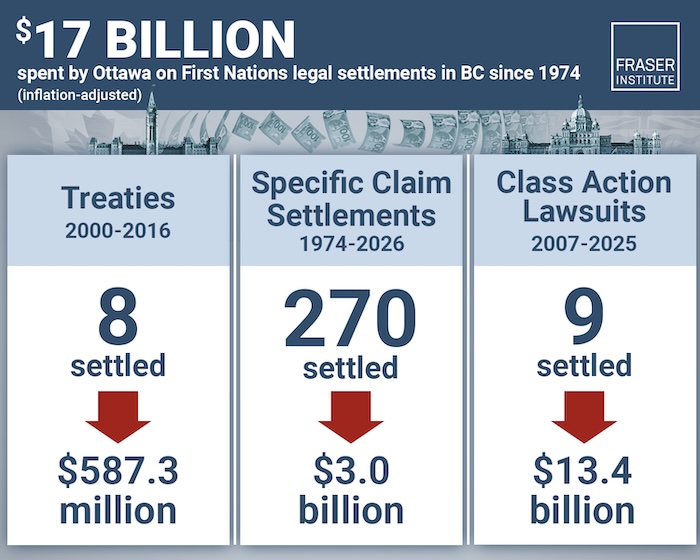
The essay finds that between 1974/75 and 2025/26, Ottawa paid out $29.4 billion to First Nations to settle specific claims—essentially those cases where the court ruled the federal government had violated treaty rights or the Indian Act in the past.
Crucially, the number of claims settled and the value of the claims settled significantly increased starting in 2017/18, and it peaked in 2024/25 when 69 claims were settled for a total of $7.3 billion that year alone.
But specific claims are only one form of legal compensation for First Nations. Increasingly, class actions and other litigation based on claims of mistreatment of rights violations have been brought against the federal government, including for residential schools, the “sixties scoop,” safe drinking water, and more.
Settling class action suits has cost Ottawa an estimated $83.2 billion since 2007.
“Because Ottawa’s compensatory payments are for historical wrongs, the number of claims—and the amount taxpayers need to pay—should be going down, not up, but that is not the case,” Flanagan said.
“The significant amount of money that the federal government has paid out, particularly in recent years, acts as an incentive to attract even more legal claims and class action lawsuits to be filed. This all begs the question of whether or not these efforts are improving the wellbeing of indigenous populations in Canada.”
Media Contact:
Tom Flanagan, Senior Fellow
Fraser Institute
To arrange media interviews or for more information, please contact:
Erin Clemens, Fraser Institute
604-688-0221 ext.615
erin.clemens@fraserinstitute.org
View Comments
The Fraser Institute is an independent Canadian public policy research and educational organization with offices in Vancouver, Calgary, Toronto, and Montreal and ties to a global network of 86 think-tanks. Its mission is to measure, study, and communicate the impact of competitive markets and government intervention on the welfare of individuals. To protect the Institute’s independence, it does not accept grants from governments or contracts for research. Visit fraserinstitute.org.
Follow the Fraser Institute on Twitter | Like us on Facebook